In today’s world, perhaps the most similar person to Rockefeller or Carnegie is the current richest person in the world, Bill Gates. As the founder of Microsoft, Gates has a net worth of $79.2 billion; while this pales in comparison to the earnings of Carnegie or Rockefeller, it is much more difficult to earn those (adjusted) numbers in modern times. Anyhow, Gates should also be considered a captain of industry rather than a robber baron. He is an extremely charitable individual who contributes to the fights against diseases of all forms, from malaria to STDs. In his lifetime, he has donated a whopping total of over $36 billion. Like Carnegie and Rockefeller had, Gates uses his money to make good change rather than bad.
Tuesday, June 9, 2015
Rockefeller Barons and Carnegies of Industry?
In today’s world, perhaps the most similar person to Rockefeller or Carnegie is the current richest person in the world, Bill Gates. As the founder of Microsoft, Gates has a net worth of $79.2 billion; while this pales in comparison to the earnings of Carnegie or Rockefeller, it is much more difficult to earn those (adjusted) numbers in modern times. Anyhow, Gates should also be considered a captain of industry rather than a robber baron. He is an extremely charitable individual who contributes to the fights against diseases of all forms, from malaria to STDs. In his lifetime, he has donated a whopping total of over $36 billion. Like Carnegie and Rockefeller had, Gates uses his money to make good change rather than bad.
Wednesday, May 6, 2015
Freedom From Multiple Directions
Lincoln’s open letter to Horace Greeley, written early on in the war, exhibits neither freedom from above nor below. In fact, the document itself is not entirely about slavery, focusing more upon the union and what it needed for success. In the letter, Lincoln writes, “My paramount object in this struggle is to save the Union and is not either to save or to destroy slavery.” By writing this, Lincoln shows that at this time, freeing slaves was not of the highest importance in his mind. The thing that he wanted most was simply a better future for the union, which at that time may or may not have been dependent on the emancipation of slaves.
Many of the other Lincoln documents exhibited freedom from above. These showed Lincoln, as well as others with power over the country, as those who gave freedom. The image mentioned above shows this, because Lincoln himself is shown freeing slaves from their chains and giving them freedom. In addition to the image, Lincoln also gave many speeches (given after his open letter) in which he presented himself as wanting to free slaves. In the Emancipation Proclamation Lincoln stated, “all persons held as slaves within any state or designated part of a State, the people whereof shall then be in rebellion against the United States, shall be then, thenceforward, and forever free”. In addition to this, he also said the freeing of slaves was “an act of justice, warranted by the Constitution, upon military necessity”. This clearly shows both Lincoln’s drive to free slaves as well as his belief that this was important to the country as a whole. The Gettysburg Address had Lincoln proclaiming that, “Now we are engaged in a great civil war, testing whether that nation or any nation so conceived and so dedicated can long endure.” While this again shows Lincoln’s belief that the freedom of slaves would strengthen the country, he also said that “The brave men, living and dead who struggled here have consecrated it far above our poor power to add or detract”. By saying this, Lincoln argues that the abolishment of slavery is a just cause, and that those who fight for this cause are brave and honorable. Lastly, in his second inaugural speech, Lincoln stated, “These slaves constituted a peculiar and powerful interest. All knew that this interest was somehow the cause of the war”. In this, Lincoln directly acknowledges that the war’s true center was slavery, and that the abolition of slaves was the main goal. Though his feelings changed over time, Lincoln’s eventual view was that slavery should be abolished.
Freedom from below is the opposite circumstance of freedom from above; instead of the freedom coming down from those with power, freedom is fought for by those who seek it. Document X, which is a letter from General Burnside, shows panic caused by slaves fighting back. In the letter, it is written that “They seemed to be wild with excitement and delight— they are now a source of very great anxiety to us; the city is being overrun with fugitives from surrounding towns and plantations”. Due to taking matters into their own hands, the slaves were able to push themselves forward in the fight for freedom, rather than waiting for an executive to do something about their situation. Document Y, which can be seen to the top right, shows slaves that have left their plantation in order to meet with union soldiers. Again, the slaves are fighting for themselves, and their own freedom, rather than waiting for someone else to come up with a solution to their problem.
In all, freedom to the slaves came mostly from above. Without Lincoln’s help, no true advances could be made in the fight for freedom. Both forms did exist, but Lincoln’s involvement had the most impact. Also, power coming from above and below is still a topic which is relevant today. The riots occurring in Baltimore bring attention to a significant issue in today’s world: police brutality,
and the question of how far is too far. This is definitely an example of power coming from below, as those who are feeling oppressed are fighting back in order to be heard and make a difference. In other news of late, Bruce Jenner recently came out as transgender. Due to being such a high profile television personality, Bruce was able to present his story in front of many who were unfamiliar with this subject before, bringing awareness to a topic that few had really known much about. In a way, he has become a voice for an entire community, and has become an example of power coming from above.
http://www.edline.net/files/_DMF2g_/25617cd6768f5fcd3745a49013852ec4/Docs_XY_Above__Below.pdf
http://www.edline.net/files/_DMF3y_/abfc09536fdb31443745a49013852ec4/Freedom_to_the_Slaves.jpg
http://www.ibtimes.com/baltimore-riots-2015-city-residents-struggle-under-poverty-income-inequality-mass-1899732
Saturday, April 11, 2015
Scavenging a Hunt Through the Civil War
![]() |
| QR Code to Google Doc |
![]() |
| Google Doc |
The ultimate victor of the western battles was the union, mainly due to having a larger army. In the Battle of Shiloh, the confederacy was simply overwhelmed by the numbers that the union had. After the initial attack by the union, the confederacy launched a fairly successful counterattack, but the many waves of union soldiers stopped the confederacy from causing too much damage. Additionally, in the Battle of Vicksburg, the Confederate chief’s sole choice was to retreat from battle after suffering 29,491 casualties and not being able to keep up with the union’s size. In all, the confederacy could not keep up with the union, not by lack of strategy, but simply by lack of soldiers.
In addition to the west, the union also dominated in the naval battles of the civil war. This can be attributed to the fact that the union had an advantage in being the aggressors as well as poor confederate defense and preparation. The Battle of Fort Henry had the confederacy running out of ammunition, and many of the soldiers were fresh recruits with little training. Also, the location of the fort was poor, due to being very exposed as well as on low ground. In addition to the Battle of Fort Henry, the Surrender of Fort Donelson also involved poor confederate strategy. Instead of deciding to retreat from the fort prior to union attack, General Gideon Pillow put his troops back into their posts. Due to, again, a poor location, the union were able to come out of the battle victorious. Overall, the confederacy was generally dominated by the union in the naval battles due to having to defend from all directions, as well as not having adequate preparation.
Though the western and naval theaters had a clear victor in the union, the victor of the eastern theater is more ambiguous. Either side could have been argued as being more successful in that theater; even so, the confederacy seems to just edge out the union. In the war, the main motivations of the confederacy were to defend, hold their ground, and make sure that the no big changes would occur in the country due to union victory. Because of this, the confederacy were able to achieve their goal in the east. In the second battle of Bull Run, the union was simply overwhelmed by confederate strategy, which consisted of a completely unexpected counterattack. This led to a large loss of union soldiers as well as being held off from their goal. Additionally, the Battle of Fredericksburg also showed the confederacy with a better strategy than that of the union. With poor communication inside the union army, the confederacy were able to create a choke point which led to an easier way to defend their position and, ultimately, victory. Though the confederacy may not have led many attacks in the east, they were still able to defend themselves (unlike the results of the west and navy) through their stronger strategy.
In class, a scavenger hunt was a great way to learn this material. It made the lesson enjoyable and gave a way to learn the material without having to sit in a classroom taking down notes. Creating the Google Doc gave a way to learn the intricacies of your own battle, and finding the others around the school presented many patterns while teaching the material without going into too much detail.
Wednesday, March 18, 2015
A Nation Divided
Pre Civil War, the United States was filled with tension revolving around the topic of slavery. Views on the topic changed by region, which can be seen in the results of the presidential election of 1860. As can be seen in the image to the right, the Northwest and West supported Lincoln, while the South supported Breckinridge. Lincoln was against slavery while Breckinridge believed there should be no laws against slavery. This clearly shows the division of beliefs, from antislavery views in the North to pro-slavery views in the South. Apart from those two candidates, however, Missouri supported Douglas. Missouri would support Douglas because of their geographic proximity to Kansas and Nebraska, with Douglas’ support of popular sovereignty. These people believed in popular sovereignty and wanted to make decisions based on slavery for themselves. Lastly, the border states (Tennessee, Kentucky, West Virginia and Virginia) supported Bell. Bell believed in keeping the country the same as it was, with no major changes made to the system. The people of the border states supported this viewpoint because they didn’t want to be in the middle of any fighting between the north and south that would come of attempts to make change.
After learning this information, our class was to make a video about the election and its surrounding events through their primary sources. To do this, we used the site Civil War in Art for research and Educreations to create the actual video, which is below.
Thursday, March 12, 2015
North v. South at the Dawn of the Civil War
With the data above, a conclusion can be made that the northerners were advantageous to southerners heading into the civil war. The first and arguably most important statistic was the total number of people in each region, and the north more than doubled the south. This is a very important statistic due to the need of troops, and a need for help in other areas as well. Also very important were the resources available to both sides. The north greatly overpowered the south in all three of these areas, which were railroad mileage, yearly value of manufactured goods and number of industrial workers. A larger railroad mileage made transportation easier when the north needed supplies or troops, the value of manufactured goods helped with funding while being used against the south, and a larger industry allowed for more workers to produce useful weapons and gunpowder. However, even with all of these benefits, the south had a great advantage on their side as well: slaves. Slave labor produced many of the country’s needs at the time, and could be crucial as the south would have many materials that the north didn’t. Even so, the north’s benefits still far outweighed the south’s, giving them an advantage going into the war.
Sources:
Sunday, March 8, 2015
The Elephant in the Room
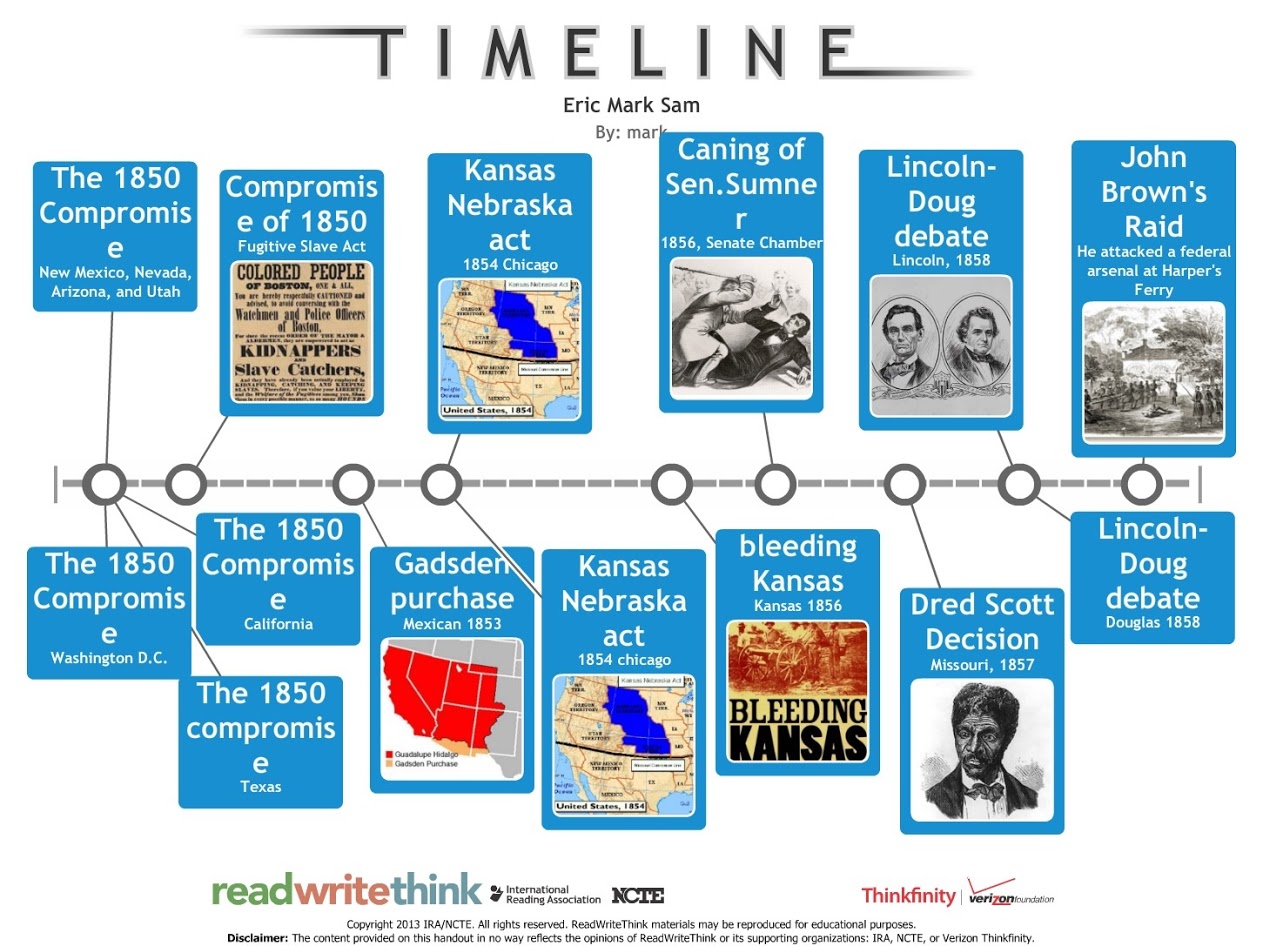
The Compromise of 1850 was a result of the tension between the north and south regarding slavery, with both sides arguing for their cause and what was viewed as “equal”. The compromise occurred as a result of the Missouri Compromise of 1820, along with the gold rush to California. After the Missouri Compromise balanced the number of slave states and free states, the gold rush complicated matters. Due to its growing population, California requested to become a free state; as there was already a balance between the number of slave and free states, California would only undo what had been done in the past. Due to this, the five-part Compromise of 1850 was created. In the Compromise, there were two portions which were anti-slavery, and three which supported slavery. The first part of the Compromise which opposed slavery stated that the slave trade would be illegal in Washington D.C., while slavery itself would still remain legal. In addition to this, the Compromise also stated that California would be a free state. The first pro-slavery part of the compromise was for Texas to be paid $10 million in exchange for some land, but with this money it would be able to pay off its debt to Mexico. With this, the territories of New Mexico, Nevada, Arizona and Utah would be organized without slavery mentioned. As these territories are in the southwest portion of the country, they would be surrounded with slavery advocates and most likely be influenced by them. The last part of the Compromise was added in order to counteract the imbalance created by the admission of California as a free state; the Fugitive Slave Act. This required the common people to assist in the recovery of fugitive slaves. With this, slaves would not have the rights to a jury trial.
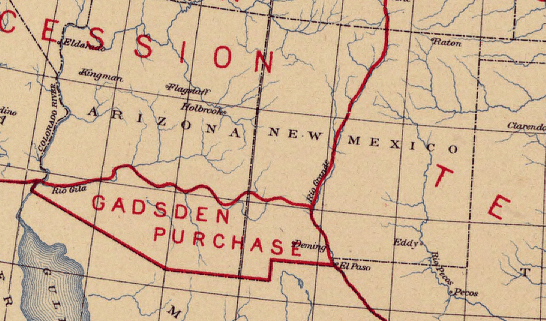
A couple years earlier, in the treaty of Guadalupe Hidalgo, the United States paid $15 million for a region consisting of Nevada, California, Utah, Arizona and New Mexico. Five years later, a much smaller plot of land was purchased for $10 million dollars; this land was known as the Gadsden Purchase. With this land, the U.S. planned to build a transcontinental railroad, which would give those in the south easier access to the west. This event was one which supported slavery due to the location of the railroad. It would make it easier to move slaves, as well as pro-slavery citizens, to the west and new parts of the country.
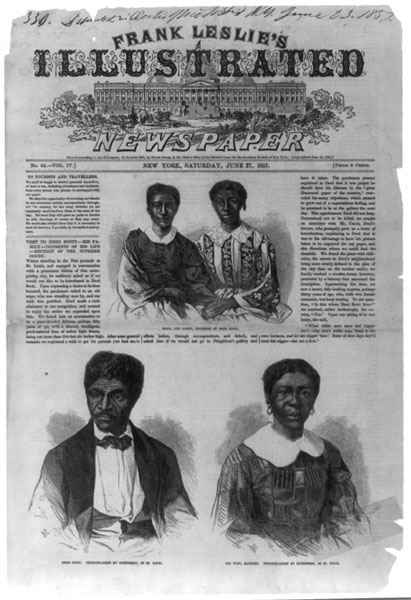
Four years after the Gadsden Purchase, Dred Scott, an enslaved man living in Missouri, sued his owner. He and his wife Harriet made the argument that they were free, due to previously living in a state in which slavery was illegal. The case made it to the Supreme Court, where a 7-2 ruling was made against the Scotts’. With this ruling came three lasting effects which had a great impact on slaves. One was that slaves could no longer sue in court, due to not being citizens of the country. The second was that slaves could not win freedom by simply moving to or living in a free state or territory, which hurt movements such as the underground railroad which had previously relied on this principle. Lastly, the Missouri Compromise of 1820 was ruled unconstitutional. Due to this, slavery was no longer illegal, in any state. The ruling, and the three effects that came of it were all pro-slavery, and hurt slaves’ chances for freedom in the future.
A final event which exhibited the tensions between the north and the south was John Brown’s Raid at Harper’s Ferry, Virginia. John Brown attacked the federal arsenal there, hoping to seize the weapons and give hope to the enslaved that they could rebel against their captors. Brown and his followers had hopes of ending slavery and bringing a moral renewal to the states. However, the raid was unsuccessful, and Brown was hanged because of his role in the attack. With his death, racial tension was further revealed through the reaction to Brown’s death. Northerners hailed Brown as a martyr of justice, while southerners were outraged and denounced him as a criminal who had tried to spark a rebellion.
All of the previously mentioned events were fueled by the racism in the United States at the time; however, the fact that nothing major happened after these events proves that it was not being fully discussed in government for its physical implications and the dangerous things that were happening in society. Because of this, it can be viewed as the “elephant in the room”.
Friday, February 27, 2015
Antebellum Slavery
The most recent topic we have been discussing in class is the resurge of slavery in the early 19th century. In doing this, two specific aspects were focused upon: how, economically and politically, slavery became entrenched in American society, and also the ways in which slavery has negative impacts on the human being. In order to complete this task, we examined the constitution, looked at slave population in relation to total revenue, and then discussed various individuals involved in the slave trade. In the end, slavery became entrenched in the United States due to the constitution and the economic benefit. In addition to this, slavery sacrifices human interest in exchange for profit, and slaves are treated in an inhumane way.
Slavery became entrenched in the United States for both political and economic reasons. In a political sense, slavery is a part of the constitution, and in several clauses slavery is specifically mentioned. For example, in Article 4, Section 2, Clause 3, it is stated that, “No Person held to Service or Labour in one State, under the Laws thereof, escaping into another, shall, in Consequence of any Law or Regulation therein, be discharged from such Service or Labour, but shall be delivered up on Claim of the Party to whom such Service or Labour may be due”. Though this refers to slaves not having the ability to escape from their owners, others mention taxes relating to the slave trade as well as a slave’s representation in Congress. Due to all of these, slavery was simply a part of the United States, with as much importance as any other law or practice.
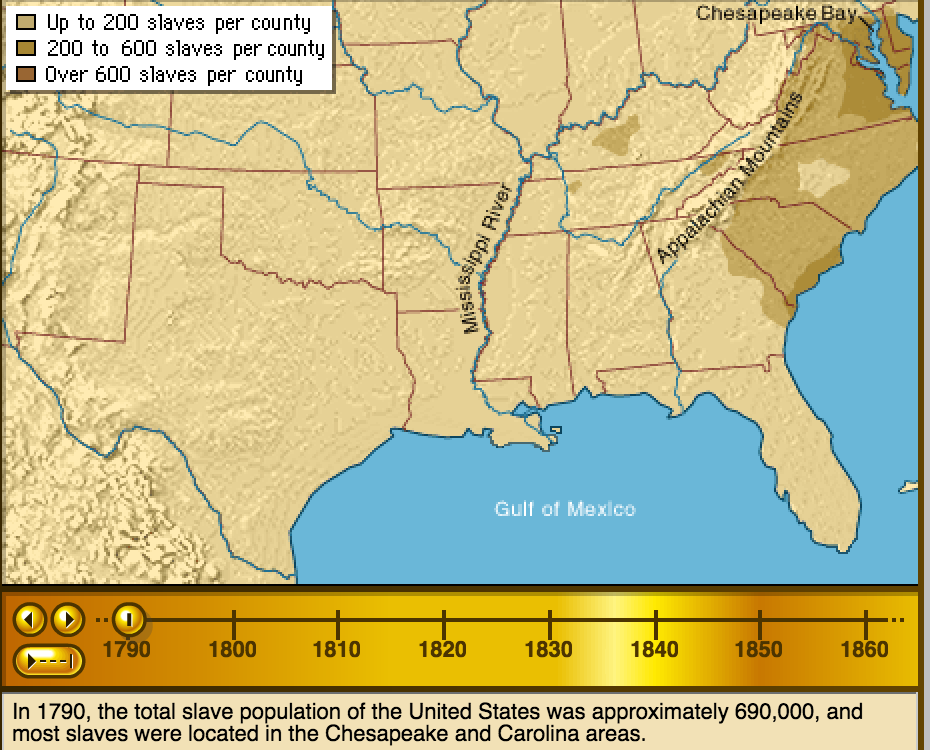
In addition to this political explanation, slavery also became entrenched through the economic benefits provided. A big factor of slavery’s contribution to the economy was the cotton gin, invented by Eli Whitney in 1792. The cotton gin removed seeds from cotton bolls, greatly increasing a process which had previously involved slaves hand-picking each individual seed. With the cotton gin came a greater need for slaves, however, due to the economic benefits of a greater cotton production. In 1790, close to the time when the cotton gin was invented, there were approximately 690,000 total slaves in the United States. In this period, 1.5 million pounds of cotton were produced. In 1860, 70 years later, there were around 3,954,000 total slaves, a 473% increase, with 2.28 billion pounds of cotton produced, a 151,900% increase. Cotton exports produced $191.8 million, 57% of the nation’s total export revenue. While the south clearly used slavery to their economic advantage, the north also benefitted from the abundance of cotton. Without the boom in cotton production, the industrial revolution may not have had such a strong effect, as the supply may not have been able to keep up with demand.
With the economic benefits of slavery comes a morality grey area, with many different viewpoints as to what is acceptable and what is not in regards to treatment. Four specific individuals of the antebellum period stand out as having four very different viewpoints: John Brown, George Fitzhugh, Frederick Douglass and Prince Abdul Rahman. John Brown was squarely on the side of anti-slavery, and led many violent protests in attempts to make change. He believed in using violent means to end slavery, with the intent of slave revolt. One particularly violent example of such an occurrence was the raid of the federal arsenal in Harper’s Island, Virginia. The raid was unsuccessful, and Brown was captured and hanged. Even so, the response from northerners and southerners speaks to the contrast in viewpoints. While those in the north supported Brown's actions and believed him to be a martyr for the anti-slavery cause, those in the south denounced his motive and were outraged by his actions.
Contrary to John Brown, George Fitzhugh grew up on a plantation and was pro-slavery. In Fitzhugh's mind, there was no moral issue surrounding slavery, because all slaves were content with what they were doing in their lives. In his book Cannibals Alll or Slaves Without Masters, he wrote, "The negro slaves of the south are the happiest, and in some sense, the freest people of the world. The children and the aged infirm work not at all, and yet have all the comforts and necessities of life provided for them". According to Fitzhugh, slaves were happy due to having no responsibilities and having everything given to them by their owners.
Unlike John Brown and George Fitzhugh, Frederick Douglass was not born a free man. He was born into slavery and had to educate himself, breaking the law in the process. He escaped from his owner twice, successful in his second attempt. After gaining freedom, Douglass became an active abolitionist, not afraid to voice his opinion and to spread his ideas to the public. In a speech he gave on July 5, 1882 in Rochester NY, Douglass proclaimed, “What, to the American slave, is your 4th of July? I answer, a day day that reveals to him, more than all other days in the year, the gross injustice and cruelty to which he is the constant victim. To him your celebration is a scam... a thin veil to cover up crimes which would disgrace a nation of savages”. By saying this, Douglass brings up a viewpoint that was seldom heard in the period, due to slaves having no say. That, despite efforts to free slaves, the nation as a whole is at extreme fault for being involved in the slave trade and using slaves to its advantage.
It is safe to say that Prince Abdul Rahman of Futa Jallon, Africa had an altogether unique perspective, as shown in the film Prince Among Slaves. Taken from his homeland and sold for food, guns and rum, he endured an unimaginable life filled with pain and struggle. He is an example of how slavery can rip away every shred of human dignity. Upon arriving to his owner’s plantation, he was forced to cut his hair, which in Africa had been a sign of nobility. Also, later in life, after escaping and then returning due to the realization that he had nowhere else to turn to, his owner’s wife put her foot on his face, which was a war symbol of submission. Lastly, even upon being granted freedom, Rahman had few options as to how he could reconstruct his life. While a slave he had married a woman named Isabella and had children. Later on, he and Isabella had been granted freedom, while their children had not been. In the attempt to earn money to free their children, Isabella and Prince Abdul became sick, and had only raised half of the funds necessary to free their children before they were put under pressure to leave the U.S.. Rahman died four months after departing, and never made it back to Futa Jallon.
Subscribe to:
Posts (Atom)