Thursday, March 12, 2015
North v. South at the Dawn of the Civil War
With the data above, a conclusion can be made that the northerners were advantageous to southerners heading into the civil war. The first and arguably most important statistic was the total number of people in each region, and the north more than doubled the south. This is a very important statistic due to the need of troops, and a need for help in other areas as well. Also very important were the resources available to both sides. The north greatly overpowered the south in all three of these areas, which were railroad mileage, yearly value of manufactured goods and number of industrial workers. A larger railroad mileage made transportation easier when the north needed supplies or troops, the value of manufactured goods helped with funding while being used against the south, and a larger industry allowed for more workers to produce useful weapons and gunpowder. However, even with all of these benefits, the south had a great advantage on their side as well: slaves. Slave labor produced many of the country’s needs at the time, and could be crucial as the south would have many materials that the north didn’t. Even so, the north’s benefits still far outweighed the south’s, giving them an advantage going into the war.
Sources:

Sunday, March 8, 2015
The Elephant in the Room
 Slavery was a major part in the United States in the early 19th century, and created much tension between the north and south due to differing beliefs regarding the topic. Due to this tension, several events (based in the argument of slavery) occurred leading up to the civil war. In class, we made a timeline of these events, placing those which were anti-slavery above the line and pro-slavery below the line. A conclusion can be made that during this time, slavery was the “elephant in the room”, due to the events which took place and the motivations with which they were fueled.
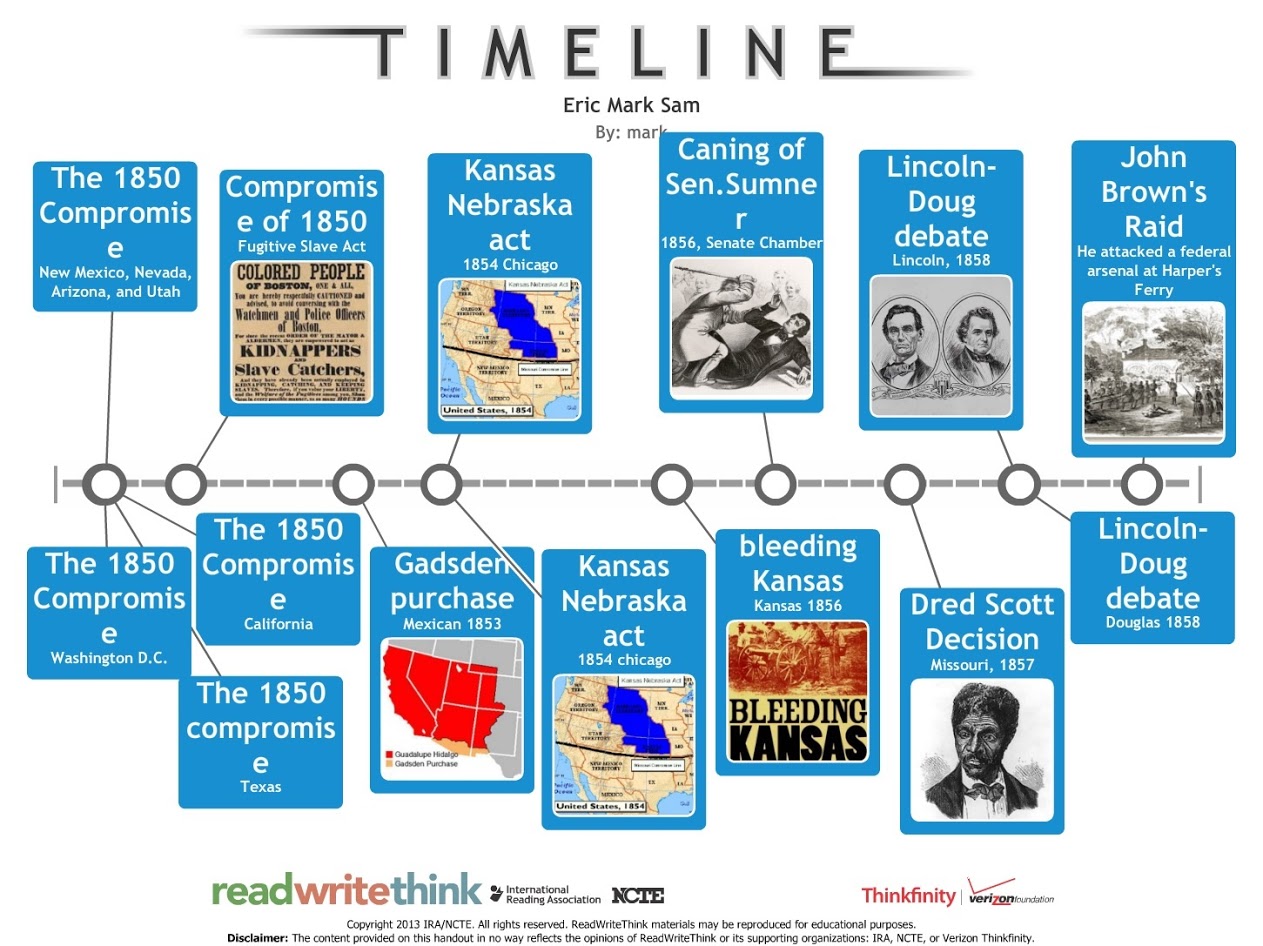
The Compromise of 1850 was a result of the tension between the north and south regarding slavery, with both sides arguing for their cause and what was viewed as “equal”. The compromise occurred as a result of the Missouri Compromise of 1820, along with the gold rush to California. After the Missouri Compromise balanced the number of slave states and free states, the gold rush complicated matters. Due to its growing population, California requested to become a free state; as there was already a balance between the number of slave and free states, California would only undo what had been done in the past. Due to this, the five-part Compromise of 1850 was created. In the Compromise, there were two portions which were anti-slavery, and three which supported slavery. The first part of the Compromise which opposed slavery stated that the slave trade would be illegal in Washington D.C., while slavery itself would still remain legal. In addition to this, the Compromise also stated that California would be a free state. The first pro-slavery part of the compromise was for Texas to be paid $10 million in exchange for some land, but with this money it would be able to pay off its debt to Mexico. With this, the territories of New Mexico, Nevada, Arizona and Utah would be organized without slavery mentioned. As these territories are in the southwest portion of the country, they would be surrounded with slavery advocates and most likely be influenced by them. The last part of the Compromise was added in order to counteract the imbalance created by the admission of California as a free state; the Fugitive Slave Act. This required the common people to assist in the recovery of fugitive slaves. With this, slaves would not have the rights to a jury trial.
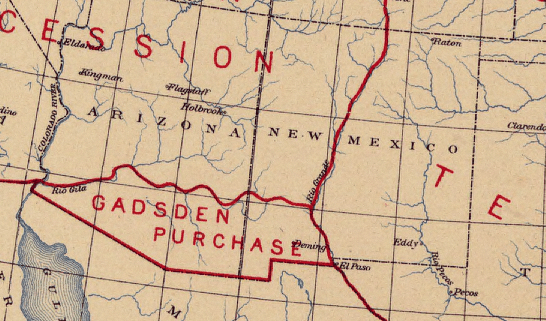 |
A couple years earlier, in the treaty of Guadalupe Hidalgo, the United States paid $15 million for a region consisting of Nevada, California, Utah, Arizona and New Mexico. Five years later, a much smaller plot of land was purchased for $10 million dollars; this land was known as the Gadsden Purchase. With this land, the U.S. planned to build a transcontinental railroad, which would give those in the south easier access to the west. This event was one which supported slavery due to the location of the railroad. It would make it easier to move slaves, as well as pro-slavery citizens, to the west and new parts of the country.
Four years after the Gadsden Purchase, Dred Scott, an enslaved man living in Missouri, sued his owner. He and his wife Harriet made the argument that they were free, due to previously living in a state in which slavery was illegal. The case made it to the Supreme Court, where a 7-2 ruling was made against the Scotts’. With this ruling came three lasting effects which had a great impact on slaves. One was that slaves could no longer sue in court, due to not being citizens of the country. The second was that slaves could not win freedom by simply moving to or living in a free state or territory, which hurt movements such as the underground railroad which had previously relied on this principle. Lastly, the Missouri Compromise of 1820 was ruled unconstitutional. Due to this, slavery was no longer illegal, in any state. The ruling, and the three effects that came of it were all pro-slavery, and hurt slaves’ chances for freedom in the future.
A final event which exhibited the tensions between the north and the south was John Brown’s Raid at Harper’s Ferry, Virginia. John Brown attacked the federal arsenal there, hoping to seize the weapons and give hope to the enslaved that they could rebel against their captors. Brown and his followers had hopes of ending slavery and bringing a moral renewal to the states. However, the raid was unsuccessful, and Brown was hanged because of his role in the attack. With his death, racial tension was further revealed through the reaction to Brown’s death. Northerners hailed Brown as a martyr of justice, while southerners were outraged and denounced him as a criminal who had tried to spark a rebellion.
All of the previously mentioned events were fueled by the racism in the United States at the time; however, the fact that nothing major happened after these events proves that it was not being fully discussed in government for its physical implications and the dangerous things that were happening in society. Because of this, it can be viewed as the “elephant in the room”.
Friday, February 27, 2015
Antebellum Slavery
The most recent topic we have been discussing in class is the resurge of slavery in the early 19th century. In doing this, two specific aspects were focused upon: how, economically and politically, slavery became entrenched in American society, and also the ways in which slavery has negative impacts on the human being. In order to complete this task, we examined the constitution, looked at slave population in relation to total revenue, and then discussed various individuals involved in the slave trade. In the end, slavery became entrenched in the United States due to the constitution and the economic benefit. In addition to this, slavery sacrifices human interest in exchange for profit, and slaves are treated in an inhumane way.
Slavery became entrenched in the United States for both political and economic reasons. In a political sense, slavery is a part of the constitution, and in several clauses slavery is specifically mentioned. For example, in Article 4, Section 2, Clause 3, it is stated that, “No Person held to Service or Labour in one State, under the Laws thereof, escaping into another, shall, in Consequence of any Law or Regulation therein, be discharged from such Service or Labour, but shall be delivered up on Claim of the Party to whom such Service or Labour may be due”. Though this refers to slaves not having the ability to escape from their owners, others mention taxes relating to the slave trade as well as a slave’s representation in Congress. Due to all of these, slavery was simply a part of the United States, with as much importance as any other law or practice.
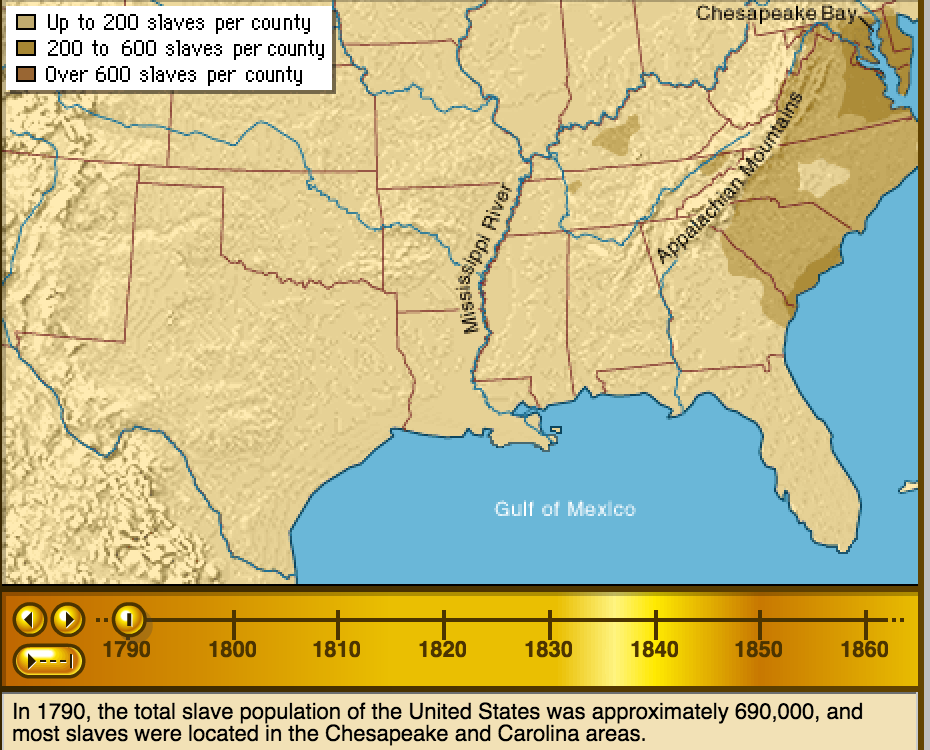
In addition to this political explanation, slavery also became entrenched through the economic benefits provided. A big factor of slavery’s contribution to the economy was the cotton gin, invented by Eli Whitney in 1792. The cotton gin removed seeds from cotton bolls, greatly increasing a process which had previously involved slaves hand-picking each individual seed. With the cotton gin came a greater need for slaves, however, due to the economic benefits of a greater cotton production. In 1790, close to the time when the cotton gin was invented, there were approximately 690,000 total slaves in the United States. In this period, 1.5 million pounds of cotton were produced. In 1860, 70 years later, there were around 3,954,000 total slaves, a 473% increase, with 2.28 billion pounds of cotton produced, a 151,900% increase. Cotton exports produced $191.8 million, 57% of the nation’s total export revenue. While the south clearly used slavery to their economic advantage, the north also benefitted from the abundance of cotton. Without the boom in cotton production, the industrial revolution may not have had such a strong effect, as the supply may not have been able to keep up with demand.

With the economic benefits of slavery comes a morality grey area, with many different viewpoints as to what is acceptable and what is not in regards to treatment. Four specific individuals of the antebellum period stand out as having four very different viewpoints: John Brown, George Fitzhugh, Frederick Douglass and Prince Abdul Rahman. John Brown was squarely on the side of anti-slavery, and led many violent protests in attempts to make change. He believed in using violent means to end slavery, with the intent of slave revolt. One particularly violent example of such an occurrence was the raid of the federal arsenal in Harper’s Island, Virginia. The raid was unsuccessful, and Brown was captured and hanged. Even so, the response from northerners and southerners speaks to the contrast in viewpoints. While those in the north supported Brown's actions and believed him to be a martyr for the anti-slavery cause, those in the south denounced his motive and were outraged by his actions.
Contrary to John Brown, George Fitzhugh grew up on a plantation and was pro-slavery. In Fitzhugh's mind, there was no moral issue surrounding slavery, because all slaves were content with what they were doing in their lives. In his book Cannibals Alll or Slaves Without Masters, he wrote, "The negro slaves of the south are the happiest, and in some sense, the freest people of the world. The children and the aged infirm work not at all, and yet have all the comforts and necessities of life provided for them". According to Fitzhugh, slaves were happy due to having no responsibilities and having everything given to them by their owners.
Unlike John Brown and George Fitzhugh, Frederick Douglass was not born a free man. He was born into slavery and had to educate himself, breaking the law in the process. He escaped from his owner twice, successful in his second attempt. After gaining freedom, Douglass became an active abolitionist, not afraid to voice his opinion and to spread his ideas to the public. In a speech he gave on July 5, 1882 in Rochester NY, Douglass proclaimed, “What, to the American slave, is your 4th of July? I answer, a day day that reveals to him, more than all other days in the year, the gross injustice and cruelty to which he is the constant victim. To him your celebration is a scam... a thin veil to cover up crimes which would disgrace a nation of savages”. By saying this, Douglass brings up a viewpoint that was seldom heard in the period, due to slaves having no say. That, despite efforts to free slaves, the nation as a whole is at extreme fault for being involved in the slave trade and using slaves to its advantage.
It is safe to say that Prince Abdul Rahman of Futa Jallon, Africa had an altogether unique perspective, as shown in the film Prince Among Slaves. Taken from his homeland and sold for food, guns and rum, he endured an unimaginable life filled with pain and struggle. He is an example of how slavery can rip away every shred of human dignity. Upon arriving to his owner’s plantation, he was forced to cut his hair, which in Africa had been a sign of nobility. Also, later in life, after escaping and then returning due to the realization that he had nowhere else to turn to, his owner’s wife put her foot on his face, which was a war symbol of submission. Lastly, even upon being granted freedom, Rahman had few options as to how he could reconstruct his life. While a slave he had married a woman named Isabella and had children. Later on, he and Isabella had been granted freedom, while their children had not been. In the attempt to earn money to free their children, Isabella and Prince Abdul became sick, and had only raised half of the funds necessary to free their children before they were put under pressure to leave the U.S.. Rahman died four months after departing, and never made it back to Futa Jallon.
Tuesday, February 3, 2015
The Evolution of Gender Equality
 In class recently, we have been learning about the women’s reform of the mid-19th century. In this period, women became more vocal with their demands for equality. However, society’s reactions to these demands were mixed in their acceptance level. In order to gain understanding on what a woman was expected of in this period, we examined the picture to the right. In it, a mother is shown taking care of her children, with her husband absent and presumably at work. Some of the roles shown in this picture that a woman was expected to fulfill were entertaining the children, educating them, making clothing, taking care of and training animals, and mending various household items. In addition to these roles, the curtain symbolizes the hidden nature of the woman’s job, and the little recognition she received.
In addition to this picture, we also examined the laws and practices of 1848 which related to women’s rights. A couple of these were: “It is improper for a woman to speak in public”, “In almost every state, the father can legally make a will appointing a guardian for his children in the event of his death”, and “In most states, it is legal for a man to beat his wife. New York courts ruled that, in order to keep his wife from nagging, a man could beat her with a horsewhip every few weeks”. As can be seen in just three of many laws and practices, a woman in those times had few to no rights in basically every aspect of life. Due to this, women began to stand up for themselves and give themselves a voice, both literally and figuratively. At the Seneca Falls Convention of July 1848, women finally began a movement, with the “Declaration of Sentiments and Resolutions”. In this document were such resolutions as, “Women is man’s equal - was intended to be so by the Creator, and the highest good of the race demands that she should be recognized as such”, and “The same amount of virtue, delicacy and refinement of behavior that is required if women - should also be required of men, and the same transgressions should be viewed with equal severity on both man and woman”. With these fairly modest requests, however, came both support and criticism.
The reactions to this demand for women’s rights ranged from supportive to disapproving. One disapproving newspaper, the “Oneida Whig”, wrote, "They should recollect however, the illustrious member of their bolting sisterhood who had not long worn the nether garments before she found it in her heart to disgrace her man's apparel and to cry like a woman." This shows that some thought that it was not possible for a woman to complete the role of a man. Other newspapers, one being “The Recorder”, mocked the movement. In “The Recorder”, it was written that, “The ‘Declaration’ adapts the language of that of “Independence” to the grievous bondage of woman in the nineteenth century. We need not say that we think the movement excessively silly; nevertheless many of our readers will have a curiosity..” This shows that some never gave the movement a chance, and wrote off the women without giving them a chance. Even with all of the negativity, however, there were supporters of the reform as well. One supportive newspaper, the “North Star”, wrote, “... there can be no reason in the world for denying to women the exercise of the elective franchise, or a hand in making and administering the laws of the land. Our doctrine is, that ‘Right is of no sex.’”. This newspaper may have had an unpopular opinion in supporting the reform, but it shows that the movement still had its support from some members of society.
The United States has come a long way in gender equality, and women and men mostly have the same rights now, contrary to the time of the reform. However, it can’t be said that men and women have equal opportunity and are judged equally. Even today, some men who work in the same positions as women are paid higher, and there are still stereotypes for what fields women should and shouldn’t start a career in. A video that shows these fairly common judgments made by many is a Pantene commercial from the Philippines. In the video, men and women are shown doing the same things, with the man’s actions championed while the female is judged and labeled. For example, while a man can be seen as a “boss”, a woman in the same position can be seen as “bossy”. In all, today’s society still reacts differently to men and women, just in a different, more subtle manner.
Works Cited:
The North Star. July 28, 1848. http://www.loc.gov/exhibits/treasures/images/vc006197.jpg. Feb. 2, 2015.

Rev. G.H. Hulin, Rev. J.A. Avery, The Recorder. August 3, 1848. http://www.loc.gov/exhibits/treasures/images/vc006198.jpg. Feb. 2, 2015.
Oneida Whig. August 1, 1848. http://www.loc.gov/exhibits/treasures/images/vc006199.jpg. Feb. 2, 2015. 

Monday, January 12, 2015
The Key to Happiness
“Most of the luxuries, and many of the so-called comforts of life, are not only indispensable, but positive hindrances to the elevation of mankind. With respect to luxuries and comforts, the wisest have ever lived a more simple and meagre life than the poor. The ancient philosophers, Chinese, Hindoo, Persian, and Greek, were a class than which none has been poorer in outward riches, none so rich in inward.”
- Henry David Thoreau
Citation: Thoreau, Henry David. Walden. Boston: Ticknor and Fields, 1854.
Above is an excerpt from Henry David Thoreau’s Walden from the chapter entitled “Economy”. Thoreau was a renowned transcendentalist of the 1800’s who wrote many celebrated works; Walden is arguably his most famous. Thoreau spent two years and two months living in a house on Walden Pond in Concord MA, and wrote the majority of Walden while there. Due to this, it is a very trustworthy source to study. However, it was largely based on Thoreau’s opinions and beliefs, so it should not necessarily be believed in its entirety by the reader. In publishing his thoughts, Thoreau was attempting to get his beliefs to the public. Overall, this specific chapter focused on the common desire for wealth and things of luxury. In his writing, Thoreau exhibited many common transcendentalist beliefs relating to nature and spirituality, but he also had a few new ideas as well. As mentioned above, he spoke of the human desire for monetary success, and suggested that this desire was the reason for many people's unhappiness. Also, by living at Walden Pond for so long with so little, Thoreau used his own experiences as evidence for his arguments, at one point saying that the only necessities of life are food, shelter, fuel and clothing. Throughout the writing, Thoreau tried to convince readers to be rid of whatever material things not necessary for a comfortable life, and with this to not work so many hours; with this, they could achieve happiness.
Thursday, December 11, 2014
Andrew Jackson: a President for the People?
Recently in class, we have been learning about Andrew Jackson’s presidency, which began with his election in 1829. In learning about Andrew Jackson as a leader, we answered the question, “Is Andrew Jackson’s long-standing reputation as “the people’s president” deserved?”. Our class was split into three groups, and each group focused on one of three specific aspects of his presidency: the Bank War, Spoils System and Indian Removal Act. Jackson started the Bank War by vetoing against the Second National Bank. In doing what he did, Jackson believed that he was protecting the average man from being taken advantage of, as he thought the bank favored the upper classes. However, this ended in economic collapse, with even his supporters against his decision. In addition to the Bank War, Jackson also made the decision to choose his government officials in a Spoils System, favoring those who supported him over those with ability. He fired 919 officials, opening positions for those whom he thought had more loyalty. This system backfired when Samuel Swartwout, one of Jackson’s supporters/officials, stole 1.2 million dollars from the government. This system was also unjust and unfair, due to political views being taken into account for positions that should be given to those with actual competence. Lastly, Andrew Jackson signed the Indian Removal Act, which is the topic our group focused on. He wanted to expand the country west, and in order to do this, he would encroach on Cherokee territory. The Cherokee tribe did not want to move west, due to the fact that they lived on the land of their ancestors. Also, they believed they would not fit in the west with the other tribes, who had lived there for many years. However, Andrew Jackson informed the tribe that they would be forced to abide by the same laws as the rest of the United States, due to the fact that they would be residing in their territory. Due to this, the tribe was forced to leave, and their journey west is known as the “trail of tears”. In moving, up to 10,000 Cherokee indians died. Due to all of these things, Andrew Jackson should not be known as a people’s president. He was too focused on helping his supporters and those of lower classes, compromising the rights of the upper classes and the indians. Even though they were more independent and not as needy of governmental support, the members of the upper class and the Cherokee tribe were people too, something Andrew Jackson did not take into account.
With the information we gathered about the Indian Removal Act, our group decided to perform a skit for the class. In our skit, we decided to focus on the motivation for and initial reactions of the Indian Removal Act. The script is below.
Narrator: In a nation, Andrew Jackson wants to expand the United States, but the Cherokee Indians are in his path. Looks into the distance.
Andrew Jackson rides his mighty steed into the scene.
Indians are mid powwow. (http://youtu.be/ZNuNsKwG1RI)
Indian chief: Hello, Jacksana.
Andrew Jackson: What does that mean?
Indian chief: Devil.
A: Why do you refer to me as such?
I: You try to take our land, demolish our people and move us west, yet before you were loyal to us. Why do you do this?
A: We wish to expand our territory. You shall move voluntarily, or you will be subject to the laws of the United States.
I: We wish to remain on the land of our fathers. We have a perfect and original right to remain without interruption or molestation.
A: Then we will have to use force.
I: The west is a mysterious place. There are other tribes there, who speak different languages. We will not fit in. If staying means dying, then so be it.
A: That is your choice.
I: We are an independent nation, we do not have to abide by your laws.
A: Yes you do.
Andrew Jackson turns to leave, rides away on horse.
Wednesday, December 3, 2014
Rise of Democracy
This week in class, we have been learning about the rise of democracy in the United States. The question we were to answer was, “How should we define democracy? How democratic was the United States in the early 1800s?”. The first thing we did to do this was to establish the definition of democracy, in order to have a concrete meaning to go off from when taking down notes. After this, we made notes from various sources, which ranged from art to charts and quotes. With the notes we made, we composed a poster. On the poster, shown below, are the sources we analyzed, as well as the actual analysis as to how democratic the United States was in the early 1800s.

Subscribe to:
Posts (Atom)